video history project
home
contact
about Video History Project
site map
contribute
search
groups
resources
groups
groups lists
links
map


The Kitchen
   1971 - present
   New York City

History of The Kitchen – from The Kitchen website

The Opening of The Kitchen - June 15, 1971 - from the Vasulka Archives

Essay  on The Kitchen  - by Ben Portis, January 1992  from the Vasulka Archives


History of The Kitchen
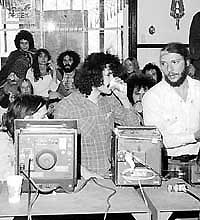
The Kitchen literally began in a kitchen. On July 5, 1971, in the unused kitchen of the Mercer Arts Center, housed in the Broadway Central Hotel in Greenwich Village, two video makers and performers invited friends to see the results of a collaborative project.

Within this atmosphere of adversity and excitement, The Kitchen grew. It grew along with the new art form it presented and gradually embraced music as part of its presentations. In 1974, it incorporated as the not-for-profit Haleakala, Inc. and moved to 59 Wooster Street in SoHo, rapidly establishing itself as the center of the downtown art world.

For the ten year period that followed, The Kitchen became a sort of hotbed of artistic activity. By this point in time, The Kitchen was also presenting performance and dance as part of its season, as well as film. Within the confines of a beautiful, columned, gallery-style loft space, this new Kitchen presented work that was both daring, non-traditional, and cutting edge. Artists would often informally gather at The Kitchen. They talked, questioned, and argued. Ideas happened. Artistic forms would merge and tradition would frequently be broken. Inevitably, through such passionate and ambitious work, many Kitchen artists broke through and achieved national prominence. Over the years, The Kitchen helped foster the careers of many innovative artists. People as diverse as Philip Glass, Laurie Anderson, Bill T. Jones and Arnie Zane, Eric Bogosian, David Byrne with The Talking Heads, Robert Longo, Peter Greenaway, Dana Reitz, Meredith Monk, Brian Eno, John Lurie, Elizabeth Streb, Robert Mapplethorpe, Cindy Sherman, Vernon Reid, Jenny Holzer, and others. It soon became apparent that with more presentations of work, wider audience interest in The Kitchen, and heavy critical attention, The Kitchen needed to expand its physical space.

 And so, in 1985, The Kitchen came of age. Through the hard work of many people, great generosity and drive, The Kitchen moved into its new and permanent home at 512 West 19th Street. The 16,500 square foot building, an old ice house built in the late 1880's, housing two of the largest black box theaters in the country. Also made possible as a result of the building's spaciousness are a Media Services department and a large administrative space which itself often serves as the backdrop for The Kitchen's role as artistic meeting place.


The Opening of The Kitchen 

This place was selected by Media God to perform an experiment on you, to challenge your brain and its perception. We will present you sounds and images, which we call Electronic Image and Sound Compositions. They can resemble something you remember from dreams or pieces of organic nature, but they never were real objects. They have all been made artificially from various frequencies, from sounds, from inaudible pitches and their beats. Accordingly, most of the sounds you will hear are products of images, processed through sound synthesizer. Furthermore, there is time, time to sit down and just surrender. There is no reason to entertain minds anymore, because that has been done and did not help. It just does not help and there is no help anyway. There is just surrender, the way you surrender to the Atlantic Ocean, the way you listen to the wind, or the way you watch the sunset. And that is the time you don't regret that you had nothing else to do.

-  June 15, 1971


Essay on The Kitchen

“There is time, time to sit down and just surrender.  There is no reason to entertain minds anymore, because that has been done and did not help, it just does not help and there is no help anyway, there is just surrender the way you surrender to the Atlantic Ocean, the way you listen to the wind, or the way you watch the sunset and that is the time you don’t regret that you had nothing else to do”

The Vasulkas, “Welcome to The Kitchen” (June 15, 1971)

 In early summer, 1971, Dimitri Devyatkin, a fresh convert to the Porta-pak subculture, approached Nam June Paik following the artist’s talk at UC, Santa Barbara to express his admiration and ask advice.  Devyatkin was about to return to his native New York – how could he get involved with the video scene that was bursting open there?  Paik told him a very exciting space had opened just days earlier in Noho.  He should go there.  Devyatkin rode a Greyhound bus to New York and on his second night back found his way to The Kitchen, at 240 Mercer Street.  He brought a tape with him and joined the Wednesday Open Video Screening, one of the first in a long-running weekly series begun by Shirley Clarke.  Other artists showing work that night included Bill Etra, Andy Mann, Jackie Cassen, Richard Lowenberg and Clarke.  In the audience were Paik, Jonas Mekas and The Kitchen’s proprietors, Woody and Steina Vasulka.  After the screening, most of the group went out for dinner and drinks into the early morning.  Within hours of turning up, Devyatkin had been welcomed and furthermore entrusted with the keys to The Kitchen (as well as those to the Vasulkas’ 14th Street studio).  They were headed to Iceland for the summer.  The 21-year-old newcomer was left in charge until they returned..

This story reflects an article of faith among the original generation of video artists – value and accommodate anyone who arrives demonstrating enthusiasm, intelligence and commitment.  Media arts curator and historian Robert Riley noted that “the opening of The Kitchen ... was an outgrowth of the Vasulkas’ interest in collaborative exchange, and their desire that community resources be shared by artists.” (1)  Among the earliest video theaters in New York, The Kitchen alone survived the makeshift times from whence it emerged.

In February 1971, the Woody and Steina Vasulka first presented programs of their tapes at Max’s Kansas City – three nights dedicated respectively to electronics, gay cabaret, and rock concerts, approximating the three broad themes with which The Kitchen would be identified: video-image processing, social-issue documentary and avant-garde music.  They showed again at Global Village and then in March at the WBAI Free Music Store, multi-monitor environments of video and audio.  Inspired by the possibilities of electronic theater, the Vasulkas pursued an initiative taken by their carpenter friend Andreas Mannik, (a.k.a. artist Andy Mann).  They leased a modest space he located in the Mercer Arts Center, an aggregation of off-Broadway stages, independent drama groups and cabarets occupying two floors of the storied Broadway Central Hotel, a grand hotel of the 19th century which had declined into a welfare residence.  (2)   On June 15, 1971 they unveiled their renovation of the former hotel kitchen, from which the organization derived its name.  (3)  Mannik fitted the room with utilitarian elegance – brick exposed on the exterior wall, ceiling-to-floor curtains over the windows facing the street, sound-proof baffles on the inner walls and an open floor upon which equipment and seats could be arranged as required.

Although The Kitchen was never a production space per se, a lab aspect acquired from a related group, known as Perception (comprised originally of Eric Siegel and Vasulkas), played a crucial role in its financial footing. (4)  Perception carried out its explorations in electronic image generation in their respective studios, but for business purposes its address was 240 Mercer.  Through Siegel, a participant in the seminal “TV as a Creative Medium” exhibition at Howard Wise Gallery in 1969 who continued to work very closely with Wise in the patents of his video synthesizers and colorizer, Perception became the first group taken in by Electronic Arts Intermix, which was also founded in 1971 by Wise shortly after he closed his gallery.  EAI’s mission, as stated to the New York State Council on the Arts, was “to assist projects undertaken by groups and not-for-profit enterprises working to explore the potentials of the electronic media as a means of expression and non-commercial communication.”  (NYSCA, through Russell Connor and its new TV/Media section, had likewise earmarked funds for media arts around the same time.)  By way of EAI , Perception received its first grant of $15,000 in autumn 1971, soon after the Vasulkas returned from Iceland.  By mutual agreement, Wise and NYSCA included, $8000 was channeled into The Kitchen, allowing Woody and Steina to draw salaries as Director and Assistant Director, although Steina’s pay ended up being put into a 50 per cent share of the rent to the Mercer Arts Center.  (Presumably Wise made up the difference from his own pockets.)  The balance of the grant was invested into equipment for Perception, from which the Vasulkas again re-directed their share towards additional monitors for The Kitchen.

This attention to high-quality equipment distinguished The Kitchen from other artists’ video collectives in New York, such as Global Village, Raindance Corporation, and the People’s Video Theater.  The Vasulkas, for instance, contributed some solid video hardware from their own studio, such as five 25" Setchell-Carlson monitors obtained in barter from Max’s Kansas City impresario Mickey Ruskin. Such production-grade gear, to which artists rarely had access, presented one major incentive to show one’s work at The Kitchen.  The union of technology to performance followed organically from the personal histories and creative dispositions of the Vasulkas.  Woody began as an industrial engineer.  Steina was an accomplished violinist.  The live interface of video technology to electronic music became a hallmark of The Kitchen, and an obvious one given the inextricable geneses of audio and video synthesizers.  With an excellent sound system in place from the start, The Kitchen soon attracted composers in addition to artists.

A music program had been intended from the beginning; La Monte Young, for instance, performed at the inaugural event.  However, it was not until the arrival a young musician and composer, Rhys Chatham, in the fall of 1971, that someone took that aspect in hand.  In October, Chatham launched the Monday night series of Electronic Music Concerts.  Four of the first five concerts featured Chatham himself (one notable evening being an improvised electro-acoustic-video collaboration between he, Dimitri Devyatkin and Woody Vasulka) but soon many of New York’s audacious new composers and performers were appearing, including Maryanne Amacher, Emmanuel Ghent, Frederick Rzewski, John Gibson, Henry Flynt, Tony Conrad, Phill Niblock, Gordon Mumma, Nam June Paik and Charlotte Moorman, to name but a few.  A signal change which Chatham introduced to The Kitchen, indicating a rite of growth and a minor source of irritation, was a published schedule.

A primary need of an artist-run center like The Kitchen was for its members to have time for their own work.  With a number of coordinators, each tending his or her specialty on a regular rotation, a balance between programming and creative space was achieved.  The Vasulkas were directors-at-large.  Chatham organized weekly concerts.  However, aside from Monday music, The Kitchen was almost exclusively dedicated to video in its first year.  Dimitri Devyatkin was the original video coordinator.  He brought a concern for social issues and documentary, which could not have been more different from the image-popping video sensibility of the Vasulkas.  (Woody, a Czech emigré, knew the failure of the Velvet Revolution and was famously skeptical of the liberal bias which ran through New York’s art world.)  Devyatkin, in solidarity with the leftist agendas of Raindance or Global Village, invited marginal community groups – feminists; rent strikers from Harlem and Chinatown; gay and lesbian activists; prostitutes and transvestites – to use video and see The Kitchen as a platform for their point of view.  These rather ad hoc events brought a new clientele, not only distinct from the downtown arts contingent but, even more importantly to Devyatkin’s thinking, utterly alien to the middle-class patronage which frequented the other theaters in the Mercer Arts Center.  Programming of this sort was necessarily casual, contingent and free of charge.

The interim report filed in January 1972 by Perception on its original NYSCA grant listed seven performance areas: Electronic Music Concerts, Wednesday Evening Open Screenings, Weekend Video, and Vasulka Video ( which together dominated the first year’s presentaions); and Cinema, Three-Dimensional Studies, and Dance (amounting to a handful of dates, more or less exceptional cases).  As a result, in the spring  The Kitchen was awarded a new cycle of funding, again through Howard Wise and EAI, but as a stand-alone program this time, entirely separate from Perception.  Once again, the first item of expenditure was compensation to the additional program coordinators, Devyatkin and Chatham.  A sure sign of its growing stability and stature, The Kitchen finally issued a full calendar in April, its first, with events scheduled almost every day of the month. (5)  Public support came with stipulations too, namely an insistence by funding officers that events demonstrate audience fulfilment by charging admission.  The grassroots video sessions fell by the wayside.  Devyatkin devoted his energy to a computer arts festival (6)  and an ongoing seminar on perception and cybernetics (based on the new information theory coming out of MIT), perhaps deemed to have greater aesthetic relevance.

Throughout the Vasulka era, the profile and activities of The Kitchen were tuned to the people at its heart.  Every void seemed to presented itself as an opportunity, and someone new came along to show why.  After the voluntary roles of Devyatkin and Chatham were converted to paid positions, an extraordinarily bright, charismatic, well-liked and tragic figure began to make himself available.  Shridhar Bapat was not an artist exactly (although the few tapes he produced were highly regarded by his peers), but the Brahmin son of Indian diplomats, raised in London and educated at the London School of Economics, conducted himself with artistic comportment and verve.  Highly intelligent, technically proficient, selflessly generous, Bapat elicited a general boost in goodwill which in turn made it possible to raise the level of programming.  In June 1973, the Vasulkas launched the first Kitchen Video Festival.  Bapat acted as director.  On the face of it, the Video Festival was not so different from the regular events, but its fortified roster, comprehensive and intensive, heightened the recognition of a video arts community and assured that deserving work, from anywhere, indeed any new developments, received timely exposure in the vital center, New York.  The festival earned the Vasulkas and The Kitchen a prominent story in the New York Times. (7)  From that point forward, The Kitchen figured reliably in art and music reviews by the Times, Village Voice, and Soho Weekly News, with occasional mentions in The New Yorker, Daily News and elsewhere.

By now, The Kitchen was considered the flagship of the Media Arts sections of Russell Connor’s NYSCA and Howard Klein’s Rockefeller Foundation, the place where ambitious artists expected to debut important works and an attendant audience checked the pulse of the electronic arts underground.  In September 1972, Bapat became program director.  That month, he helped Susan Milano, organize the first Women’s Video Festival, a two-week event so successful it was reprised and extended for another two weeks in October.  The Women’s Video Festival, which highlighted women as producers and women as subjects, included Milano, Steina Vasulka, Shigeko Kubota, Jackie Cassen, Maxi Cohen, Elsa Tambellini, among several other individuals and video collectives.  In generating their own identity and spirit, the festivals revived somewhat the political fervor Devyatkin earlier sought to infuse, however within a definite artistic context.  Both The Kitchen Video Festival and the Women’s Video Festival were repeated in expanded form in 1973.  The 2nd Women’s Video Festival, held at 59 Wooster Street, was the last major project Bapat undertook for The Kitchen.

On New Year’s Eve, 1972, Rhys Chatham bade farewell with a midnight concert of his compositions.  He was leaving to devote more time to his own music.  He was replaced by Jim Burton and Robert Stearns, who would lead The Kitchen through its most momentous changes since its founding.  Stearns came along almost incidentally, a reliable attendee at concerts in which Burton, his roommate, was a performer.  An instinctive manager, he noticed things to do and took up those tasks himself, as simple as making an accurate tally and record of receipts.  A telling indication of the influence Burton and Stearns exercised within The Kitchen’s directorship was a gradual adjustment to the balance of programs during the spring of 1973.  Music was given two, then three nights per week.  This was an audience-driven decision, responding to the higher attendance for concerts than video theater and screenings.

Howard Wise, concerned about changes on the horizon and organizational tensions which resisted resolution, recognized Stearns’s natural talent for organization and long range planning and began to groom him for overall management of The Kitchen.  The Vasulkas were relocating to SUNY, Buffalo, where they had been offered a dream lab at Gerald O’Grady’s Center for Media Study.  Devyatkin received a CAPS grant and decided to study film at the renowned All Union Institute of Cinema (VGIK) in Moscow.  Bapat a desperate alcoholic, turned out to be lost without the support of those who had once relied on him.  (His closest friends departed, Bapat seemed overwhelmed by his duties and began to drift and become unreliable.)  To cap matters, The Kitchen was unable to negotiate a viable renewal on its lease.  Seymour Kaback, the entrepreneur behind the Mercer Arts Center, was clearly dissatisfied with The Kitchen, which made no effort to affiliate itself with the MAC in any of its increasing press or publicity. (8)

Stearns came from the other side of the road, south of Houston Street, where he was the director of Paula Cooper Gallery.  He understood the necessity of marketing and promotion to the stable growth of an arts business, which The Kitchen had more or less become.  It became clear that The Kitchen would have to relocate.  Howard Wise and Bob Stearns discussed this step at length.  Wise envisioned a smaller space which could function as a media workshop, close in spirit to the Perception group from which The Kitchen evolved.  Stearns recognized that the success of The Kitchen came due to its audience.  If a larger space could accommodate a larger audience, the organization would gain opportunities to invest in itself, control its own direction and become less reliant on public funds, with vagaries and guidelines implicitly attached to their use.  Stearns advocated moving to Soho.  Furthermore, the time had come to incorporate The Kitchen as an autonomous not-for-profit entity.  Its budget outstripped the rest of Electronic Arts Intermix’s programs combined.

A move of only a few blocks conveyed a far greater symbolic distance.  Left behind were the populist, political dynamics of the East Village and the isolation of maverick video artists.  Soho was cool, savvy and sophisticated with a free-wheeling real estate market.  Fortunately, several developers had a genuine interest in art, as was the case with Jeff Paley, who leased a 7500 square-foot second-floor loft to The Kitchen (almost ten times its area on Mercer Street) on very generous terms.  The new space was located at 59 Wooster Street, at the corner of Broome, in a building known simply as LoGiudice, after the ground floor gallery of dealer Joe LoGiudice.  After several weeks of renovations, The Kitchen re-opened with two evenings of John Cage on December 7 & 8.  In April 1974, Haleakala, Inc. assumed control of The Kitchen from Electronic Arts Intermix.  Howard Wise discontinued further sponsorships of outside programs to focus his energies on building a new videotape distribution system.

Ben Portis, January 1992


(1) Robert R. Riley, Steina and Woody Vasulka: Machine Media (San Francisco: San Francisco Museum of Modern Art, 1996): 10.

(2) The Broadway Central was one of the “grand” hotels of the late-19th century.  Built in 1854 and later expanded onto the site of the old Winter Garden theater, the Broadway Central was where Edward Stokes shot and killed Jim Fisk (one of the sensational society murders of its day), where “Diamond Jim” Brady held court, and where the radical Russian emigré Leon Borenstein adapted a new surname from Trotsky’s Kosher Restaurant, caterers on the premises.  In 1971 the Broadway Central was a welfare hotel.

(3) The Kitchen was alternately called, at one time or another, The Electronic Kitchen, The Electronic Kitchen for Media Arts, The Kitchen-LATL [Live Audience Test Laboratory], The Kitchen & Electronic Image Lab, and the Mercer Media Repertory Theater.

(4) Early on The Kitchen was pressed into occasional service as a basic viewing-and-editing facility at a time when affordable resources were still scarce in New York.

(5) As mentioned already, calendars outlining concert series only had been issued by Chatham.  Those for February and March 1972 were the first literature acknowledging NYSCA’s support of The Kitchen.

(6) The International Computer Arts Festival, the first of three organized in conjunction with Electronic Arts Intermix (but the only one involving either Dimitri Devyatkin or The Kitchen) ran April 1–14 & 17.  Notably, it integrated various combinations of film, music, video, sculpture and performance in composite programs, something the organization had never tried before.

(7) David L. Shirey, “Video Art Turns to Abstract Imagery,” The New York Times, July 4, 1971: Arts 6.

(8) The Broadway Central Hotel and the Mercer Arts Center came to a spectacular end when an entire wall facing Broadway collapsed on August 3, 1973.

 
January 2002


back to main Groups page


contribute search resources home contact about VHP site map